
Consciousness, Psychology and Human Potential
Could Thoughts Influence Reality?
Can the way we think change the world around us, or do our beliefs simply change how we experience it?
Estimated reading time: 10 minutes
The Central Question
Can the Way You Think Change the World Around You?
At first glance, the idea sounds impossible.
How could a thought inside your head influence reality?
After all, reality appears to exist independently of what we think about it.
The weather does not change because we want sunshine.
A mountain does not move because we imagine it elsewhere.
Yet throughout history, philosophers, spiritual traditions, psychologists and scientists have all explored a version of the same question:
Do our thoughts influence our reality?
The answer depends on what we mean.
If we are asking whether thoughts can magically alter the laws of physics, there is no reliable scientific evidence that they can.
However, if we are asking whether beliefs, expectations, attitudes and intentions can shape the outcomes we experience in life, the answer becomes far more interesting.
Because in many ways, thoughts influence reality every single day.
In this investigation:
This article explores how thoughts influence attention, behaviour, perception, physical responses, confidence and decision-making.
It also examines the limits of positive thinking and why belief is powerful without being magical.
Ideas Into Action
Every Action Begins as a Thought
Before a building exists, it exists as an idea.
Before a business is launched, someone imagines it.
Before a book is written, it begins as a thought.
Every human achievement starts in the same place.
The mind.
Thoughts alone do not create reality.
Action does.
But action is often guided by thought.
In this sense, thoughts influence reality indirectly by shaping the decisions we make and the behaviours we choose.
This connection between internal thought and external action is also central to the debate explored in Free Will vs Destiny.
Expectation
The Power of Expectations
One of the most well-documented psychological phenomena is the power of expectation.
What we expect often influences how we behave.
And how we behave influences outcomes.
For example, someone who believes they can succeed may be more likely to:
- Try
- Persist
- Learn
- Adapt
- Seek feedback
- Recover from setbacks
Someone who believes failure is inevitable may:
- Give up sooner
- Avoid opportunities
- Take fewer productive risks
- Stop learning
- Interpret setbacks as proof of inadequacy
The outcome is not created by the thought alone.
The thought influences behaviour.
The behaviour influences reality.
The chain of influence:
Thoughts shape expectations.
Expectations shape behaviour.
Behaviour changes the probability of particular outcomes.
Mind and Body
The Placebo Effect
Perhaps the most famous example of belief influencing experience is the placebo effect.
In medical studies, some patients report improvement after receiving treatments that contain no active medication.
The improvement is not necessarily imaginary.
Measurable physiological and neurological changes can occur.
Researchers believe expectation can influence:
- Pain perception
- Stress levels
- Emotional responses
- Recovery experiences
- Some bodily processes
The placebo effect demonstrates that beliefs can affect the body in measurable ways.
That alone is remarkable.
It also raises wider questions about the connection between the brain, perception and the nature of consciousness.
Negative Expectation
The Nocebo Effect
The opposite phenomenon also exists.
It is called the nocebo effect.
When people expect negative outcomes, those expectations can sometimes contribute to worse experiences.
These may include:
- Increased pain
- Greater anxiety
- Stronger awareness of symptoms
- More reported side effects
- Reduced confidence in recovery
Again, thoughts are influencing perception and response.
This does not mean thoughts create illness.
Nor does it mean that people are responsible for becoming unwell.
It means expectations can affect how physical experiences are interpreted and processed.
Important distinction:
Mindset can influence experience, but it does not replace medical care, diagnosis or evidence-based treatment.
Belief and Behaviour
Self-Fulfilling Prophecies
A self-fulfilling prophecy occurs when a belief contributes to its own outcome.
Consider a student who believes they are bad at mathematics.
Because of that belief, they avoid practising.
They become anxious during lessons.
They disengage.
Their performance suffers.
The original belief then appears to be confirmed.
The belief did not directly create reality.
But it influenced behaviour in ways that helped produce the expected result.
The same principle can apply to:
- Relationships
- Work
- Education
- Health habits
- Creative projects
- Personal confidence
Beliefs can become filters through which experiences are interpreted.
This idea connects closely to how thoughts and perception shape the reality we experience.
Selective Awareness
The Role of Attention
Psychologists often note that attention shapes experience.
What we focus on tends to occupy more space in our awareness.
For example, if you buy a red car, you may suddenly notice red cars everywhere.
The cars were always there.
Your attention changed.
Similarly, people who consistently look for opportunities may notice possibilities others overlook.
People who focus exclusively on problems may overlook potential solutions.
Attention does not create reality.
It influences which parts of reality we notice.
Investigator’s note:
What we notice is not necessarily all that exists.
Our experience is shaped by what the brain selects, prioritises and interprets.
This selective process may also help explain why mystery, danger and unanswered questions can dominate our attention.
Mindset
Confidence and Performance
Thoughts can influence performance.
Athletes, musicians, public speakers, writers and business leaders often discuss the importance of mindset.
Confidence can affect:
- Decision-making
- Persistence
- Creativity
- Communication
- Stress management
- Willingness to act
This does not mean confidence guarantees success.
Preparation still matters.
Skill still matters.
Effort still matters.
Circumstances still matter.
However, thoughts influence how effectively those qualities are applied.
Confidence does not replace preparation. It helps preparation become action.
Ancient Wisdom
Ancient Perspectives on Thought
Long before modern psychology existed, many philosophical and spiritual traditions recognised the importance of thought.
Buddhism
Buddhist teachings often emphasise the role of thought, attachment and interpretation in shaping suffering and experience.
Stoicism
Stoic philosophers argued that events themselves matter less than how we interpret and respond to them.
A person may not control every event, but they retain some influence over their judgement and response.
Ancient Egypt
Ancient Egyptian concepts such as Ma’at emphasised truth, balance, order and alignment between belief, action and the wider world.
The spiritual ideas of ancient Egypt are explored further in Ancient Egyptian Concepts of the Soul.
Ancient Symbols
Symbols such as the Ankh and the Eye of Horus represented life, protection, restoration and spiritual awareness.
Across cultures, similar themes emerge:
- Thought influences perception
- Perception influences behaviour
- Behaviour influences outcomes
Popular Belief
What About the Law of Attraction?
Few topics generate as much debate as the Law of Attraction.
In its simplest form, the idea suggests that thoughts attract corresponding experiences.
Popular versions sometimes imply that thinking positively automatically produces positive outcomes.
Scientific evidence does not support claims that thoughts alone attract events through an unknown universal force.
Positive thinking by itself is not enough.
However, there is a more practical interpretation.
Positive beliefs may encourage productive actions.
Productive actions may increase the likelihood of favourable outcomes.
In this sense, thoughts influence reality through behaviour rather than magic.
A practical interpretation:
Thinking about a goal may sharpen attention.
Sharpened attention may reveal opportunities.
Recognising opportunities may lead to action.
Action may produce results.
Direction
The Role of Intention
Intention is another important concept.
Setting clear intentions helps direct attention and effort.
People who know what they are working towards are generally more effective than those without direction.
Intention can influence:
- Goal setting
- Planning
- Decision-making
- Priorities
- Persistence
- Use of time
Again, intention does not replace action.
It helps guide it.
The desire for direction and purpose is also explored in Why Humans Search for Meaning.
Prediction and Perception
The Brain as a Prediction Machine
Modern neuroscience increasingly describes the brain as a prediction engine.
The brain constantly attempts to anticipate what will happen next.
It combines:
- Past experience
- Current sensory information
- Expectations
- Memory
- Context
These predictions influence perception.
They influence behaviour.
They influence how experiences are interpreted.
In many ways, the brain is continuously constructing a working model of reality.
Thoughts play a central role in that process.
This does not mean the outside world is imaginary.
It means our conscious experience is an interpretation of information rather than a perfect recording of everything around us.
That mystery lies at the heart of the question What Is Consciousness?
Choices and Consequences
Can Thoughts Change the Future?
In one sense, absolutely.
Every decision begins with a thought.
Every goal begins with a thought.
Every innovation begins with a thought.
Thoughts shape choices.
Choices shape actions.
Actions shape outcomes.
This chain of influence affects both individual lives and society as a whole.
History itself can be viewed as the accumulated result of billions of thoughts transformed into decisions and actions.
A thought may not rewrite the laws of nature, but it can change what happens next.
Realism
The Limits of Positive Thinking
It is important to remain realistic.
Positive thinking is not a substitute for:
- Skill
- Effort
- Preparation
- Persistence
- Resources
- Support
- Opportunity
Simply wishing for success rarely produces meaningful results.
Thoughts are powerful.
But they work best when paired with action.
The most effective mindset combines:
- Optimism with responsibility
- Hope with effort
- Vision with execution
- Confidence with preparation
- Ambition with realism
Positive thinking has limits:
Not every obstacle can be overcome by attitude alone.
External circumstances, health, inequality, chance and other people’s decisions also influence outcomes.
Mental Filters
Why Beliefs Matter
Beliefs act like filters.
They influence how we interpret information and respond to challenges.
A person who believes growth is possible may react differently to setbacks than someone who believes change is impossible.
The event may be identical.
The response differs.
Over time, those responses can lead to dramatically different outcomes.
Beliefs may influence:
- Which risks we take
- Which opportunities we notice
- How we interpret criticism
- How long we persist
- How we treat other people
- What we believe is possible
This is one reason beliefs matter so much.
Thought and Experience
The Connection Between Thought and Reality
Perhaps the most accurate conclusion is this:
Thoughts do not magically control reality, but they influence how we engage with it.
They shape:
- Attention
- Decisions
- Habits
- Behaviour
- Relationships
- Confidence
- Persistence
- Interpretation
Through these mechanisms, thoughts can profoundly influence the lives we create.
They do not give us complete control.
But they affect how we respond to the parts of life we can influence.
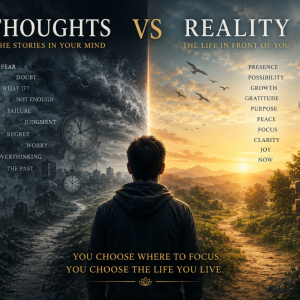
The distinction between objective events and subjective experience is explored further in Thoughts vs Reality.
Practical Insight
What We Can Learn
The practical lesson is simple.
Pay attention to your thoughts.
Not because every thought becomes reality.
But because thoughts influence the actions that shape reality.
Constructive thinking may encourage constructive behaviour.
Destructive thinking may encourage avoidance, impulsivity or defeat.
The relationship is not perfect.
Yet it is powerful.
A useful approach:
- Question automatic assumptions
- Notice repeated patterns of thought
- Separate evidence from fear
- Focus attention deliberately
- Translate intention into action
- Review results honestly
Final Thoughts
Could Thoughts Influence Reality?
In many ways, they already do.
Not through magic.
Not through supernatural control over the universe.
But through the choices, behaviours and actions they inspire.
Every achievement begins as an idea.
Every change begins as a decision.
Every journey begins with a thought.
The mind may not control the universe.
But it plays a significant role in determining how we navigate it.
Thought shapes attention.
Attention shapes decisions.
Decisions shape action.
Action shapes what happens next.
Sometimes, that is powerful enough.
Go Beyond the Article
Some Questions Lead to Bigger Mysteries
The Jonathan Chambers novels explore consciousness, hidden knowledge, perception, ancient wisdom and the extraordinary potential of the human mind.