
Consciousness And Reality
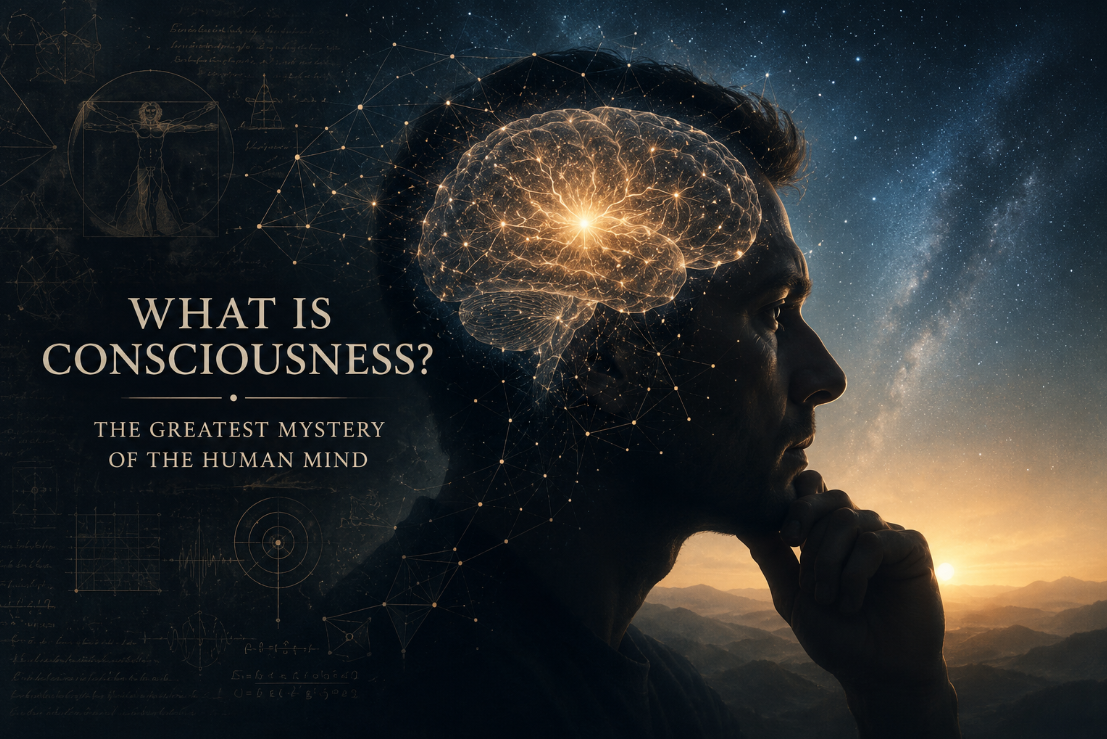
What Is Consciousness? The Greatest Mystery of the Human Mind
The question nobody has fully answered.
The Consciousness Question
The Question Nobody Has Fully Answered
You are conscious right now.
You can read these words.
You can think about their meaning.
You can remember the past, imagine the future, and experience emotions.
But have you ever stopped to ask a simple question?
What exactly is consciousness?
It sounds straightforward.
Yet despite centuries of philosophy and decades of scientific research, nobody can fully explain how consciousness works—or even what it truly is.
We understand the brain better than at any point in human history.
We can map neurons.
We can observe electrical activity.
We can identify regions responsible for speech, memory, movement, and emotion.
But one mystery remains.
How does a collection of cells and electrical signals create the experience of being you?
That question has become one of the greatest unsolved puzzles in science.
The Consciousness Question
What Is Consciousness?
At its simplest, consciousness refers to awareness.
It is your ability to:
- Experience thoughts
- Feel emotions
- Perceive the world around you
- Recognise yourself as an individual
- Make decisions
- Reflect upon your experiences
Consciousness is what transforms a biological machine into a thinking, feeling person.
Without consciousness, there is no experience.
No joy.
No fear.
No memories.
No sense of self.
The strange thing is that while we all experience consciousness directly, explaining it is incredibly difficult.
The Consciousness Question
The Hard Problem of Consciousness
One of the most famous concepts in modern philosophy is known as the Hard Problem of Consciousness.
The term was introduced by philosopher David Chalmers.
The problem is surprisingly simple.
Science can explain how the brain processes information.
It can explain how neurons communicate.
It can explain how the eyes detect light.
But none of this explains why those processes create subjective experience.
Why does seeing the colour red feel like something?
Why does listening to music create emotion?
Why do thoughts exist at all?
The gap between physical processes and personal experience remains one of science’s biggest mysteries.
The Consciousness Question
The Brain: The Control Centre
Most scientists believe consciousness emerges from the brain.
The human brain contains approximately 86 billion neurons.
These cells communicate through vast networks of electrical and chemical signals.
Every thought, memory, emotion, and decision appears connected to this activity.
Damage specific areas of the brain and consciousness can change dramatically.
People may lose memories.
Personalities can shift.
Awareness can be altered.
This strongly suggests that the brain plays a crucial role in generating conscious experience.
The question is whether the brain creates consciousness entirely—or whether it simply interacts with something deeper.
The Consciousness Question
Is Consciousness Produced by the Brain?
The dominant scientific view is that consciousness emerges from brain activity.
According to this perspective:
- The brain creates the mind.
- Thoughts arise from neural processes.
- Consciousness disappears when brain activity ends.
For many researchers, this explanation is sufficient.
The brain is an extraordinarily complex biological computer.
Consciousness is simply what happens when enough complexity exists.
Yet not everyone agrees.
Some scientists and philosophers argue that this explanation leaves important questions unanswered.
The Consciousness Question
Could Consciousness Be Fundamental?
An alternative possibility is that consciousness is not created by the brain at all.
Instead, consciousness may be a fundamental aspect of reality itself.
This idea appears in various forms across philosophy, spirituality, and even some areas of theoretical science.
In this view:
The brain may function less like a generator and more like a receiver.
Rather than creating consciousness, it may help focus or organise it.
Think of a radio.
A radio does not create music.
It receives signals and converts them into sound.
Some researchers have wondered whether the brain could operate in a similar way.
This remains speculative, but it continues to attract interest because it addresses some of the unanswered questions surrounding consciousness.
The Consciousness Question
The Mystery of Self-Awareness
Humans possess a remarkable ability.
We can think about our own thinking.
This is known as self-awareness.
You are not merely experiencing reality.
You are aware that you are experiencing reality.
You can analyse your thoughts.
Question your beliefs.
Imagine alternative futures.
Reflect on your own existence.
Very few animals appear capable of this level of introspection.
Why self-awareness evolved remains a topic of active debate.
Some believe it provided survival advantages.
Others argue it represents something more profound.
The Consciousness Question
Consciousness and Free Will
Another major question concerns free will.
Do we truly choose our actions?
Or are our decisions simply the result of brain processes operating beneath conscious awareness?
Some experiments suggest the brain begins preparing actions before we consciously decide to perform them.
This has led some researchers to question whether free will exists in the way we traditionally imagine.
Others argue that conscious awareness still plays a vital role in decision-making.
The debate continues.
What is clear is that consciousness and free will are deeply connected.
Understanding one may help us understand the other.
The Consciousness Question
Dreams and Altered States
Consciousness is not fixed.
It changes constantly.
Every day we move through different states of awareness.
These include:
- Wakefulness
- Sleep
- Dreams
- Deep meditation
- Hypnosis
- Flow states
Each state alters how we experience reality.
Dreams are particularly fascinating.
While dreaming, entire worlds can feel completely real.
People, places, conversations, and emotions arise within the mind.
Yet upon waking, we recognise the experience was generated internally.
This raises interesting questions about how consciousness constructs reality itself.
The Consciousness Question
Near-Death Experiences
One of the most debated areas of consciousness research involves near-death experiences.
Many people who have come close to death report strikingly similar experiences.
Common descriptions include:
- Moving through a tunnel
- Encountering bright light
- Feelings of peace
- Life reviews
- Encounters with deceased relatives
- A sense of interconnectedness
Researchers continue to debate these reports.
Some view them as products of brain activity under extreme stress.
Others believe they may provide clues about consciousness that science has not yet fully understood.
At present, no consensus exists.
The Consciousness Question
The Pineal Gland and Ancient Beliefs
Throughout history, many cultures attached special significance to a small structure deep within the brain known as the pineal gland.
Ancient traditions often associated it with:
- Spiritual insight
- Higher awareness
- Inner vision
- Consciousness
In the seventeenth century, philosopher René Descartes famously described the pineal gland as the “seat of the soul.”
Modern science views the pineal gland differently.
It is known to regulate sleep cycles through the production of melatonin.
Yet its symbolic role continues to fascinate those interested in consciousness and spirituality.
The Consciousness Question
Are We More Connected Than We Think?
Many philosophical and spiritual traditions share a common idea.
That beneath our individual identities, there may be a deeper connection linking all conscious beings.
Versions of this concept appear in:
- Ancient Egypt
- Hindu philosophy
- Buddhism
- Greek thought
- Indigenous traditions
- Modern spiritual movements
Science has not confirmed such ideas.
However, they continue to resonate because many people report experiences of profound connection through meditation, nature, prayer, creativity, or moments of intense emotion.
Whether these experiences reveal something fundamental about reality remains an open question.
The Consciousness Question
Why Consciousness Matters
The study of consciousness is not merely an academic exercise.
It affects some of the biggest questions humans can ask.
Questions such as:
- Who am I?
- Why do I exist?
- What happens when we die?
- Do we have free will?
- What makes us human?
- Are we connected to something larger than ourselves?
Few scientific mysteries touch so directly upon our everyday lives.
The Consciousness Question
What Does the Future Hold?
The coming decades may transform our understanding of consciousness.
Advances in:
- Neuroscience
- Brain imaging
- Artificial intelligence
- Quantum research
- Cognitive science
are providing new insights every year.
Some scientists believe we may eventually solve the mystery completely.
Others suspect consciousness may prove far stranger than we currently imagine.
Either way, the search continues.
The Consciousness Question
So What Is Consciousness?
The honest answer is surprisingly simple.
Nobody knows for certain.
We know consciousness exists because we experience it directly.
We know the brain plays an important role.
We know awareness shapes every aspect of human life.
Beyond that, the mystery remains.
And perhaps that is what makes consciousness so fascinating.
It is the one mystery we carry with us every moment of every day.
The Consciousness Question
Final Thoughts
Humanity has explored the depths of the oceans.
Mapped distant galaxies.
Split the atom.
Decoded the human genome.
Yet the greatest mystery may still lie within our own minds.
Consciousness remains the frontier we experience constantly but understand only partially.
Perhaps future science will reveal its secrets.
Perhaps some mysteries will always remain.
For now, consciousness stands as a reminder that the most profound questions are often the closest to home.
The universe is remarkable.
But so is the fact that we are able to experience it at all.
Explore Further
Explore More Questions About Consciousness and Reality
If you enjoy exploring consciousness, free will, ancient knowledge, hidden history, science, and humanity’s search for meaning, discover the Jonathan Chambers novels.
Because sometimes the greatest mysteries are not found in the stars—but within ourselves.