
Consciousness, Death And The Unknown
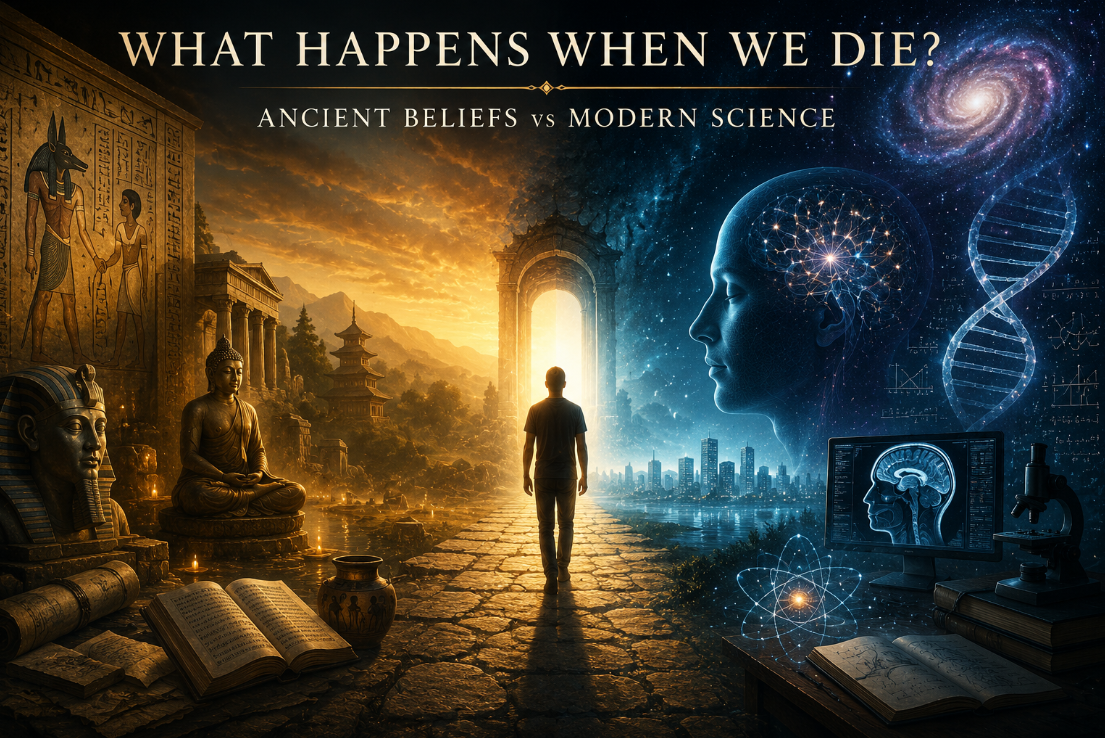
What Happens When We Die? Ancient Beliefs vs Modern Science
One question every human asks.
Life, Death And Meaning
One Question Every Human Asks
Sooner or later, everyone asks the same question.
What happens when we die?
It is perhaps the oldest question in human history.
Long before civilizations built cities, wrote books, or developed science, people were wondering what lay beyond death.
Is death the end of consciousness?
Does some part of us continue?
Is there an afterlife?
Reincarnation?
Nothing at all?
Despite thousands of years of philosophy, religion, and scientific investigation, no answer has been universally accepted.
Yet the search continues.
Why?
Because the question touches something fundamental within us.
It is not merely a scientific question.
It is a human one.
Life, Death And Meaning
Why Humans Think About Death
Unlike other animals, human beings possess a unique awareness of mortality.
We know that life is finite.
We understand that everyone we love, including ourselves, will one day die.
This awareness creates profound questions:
- Why are we here?
- Does life have a purpose?
- What happens after death?
- Is consciousness temporary or eternal?
Every culture in history has attempted to answer these questions in its own way.
The result is a fascinating collection of beliefs, ideas, and theories that continue to shape humanity today.
Life, Death And Meaning
Ancient Egypt: Life Beyond Death
Few civilizations focused on the afterlife as intensely as ancient Egypt.
The Egyptians believed death was not an ending but a transition.
Life continued beyond the physical world.
This belief influenced nearly every aspect of their society.
They built:
- Tombs
- Pyramids
- Funerary temples
- Burial chambers
They developed elaborate rituals designed to prepare individuals for the next stage of existence.
Ancient Egyptians believed various aspects of the individual survived death and continued their journey.
Their goal was not simply to avoid death.
It was to navigate what came next.
Life, Death And Meaning
Hinduism and Reincarnation
One of the world’s oldest religious traditions teaches that life is part of a much larger cycle.
According to Hindu philosophy, the soul passes through many lifetimes.
Birth.
Death.
Rebirth.
This cycle continues until spiritual liberation is achieved.
Actions performed during life influence future experiences through karma.
In this view, death is not an ending.
It is a transition between chapters of a much longer journey.
For billions of people throughout history, reincarnation has provided a meaningful framework for understanding existence.
Life, Death And Meaning
Buddhism and the Cycle of Rebirth
Buddhism shares similarities with Hindu teachings while approaching the subject differently.
According to Buddhist traditions, attachment and desire contribute to a cycle of suffering and rebirth.
The ultimate goal is enlightenment.
Once enlightenment is achieved, the cycle ends.
Buddhist teachings focus less on preserving a permanent soul and more on understanding the nature of consciousness itself.
The result is one of the most sophisticated philosophical explorations of life and death ever developed.
Life, Death And Meaning
Ancient Greece and the Immortal Soul
Several Greek philosophers also considered the possibility that consciousness survives death.
Plato believed the soul existed before birth and continued after physical death.
Other thinkers explored similar concepts.
For many ancient Greeks, the body was temporary.
The soul was enduring.
These ideas would later influence Western philosophy and religious thought for centuries.
Life, Death And Meaning
The Abrahamic Religions
Judaism, Christianity, and Islam each teach versions of life after death.
Although details differ, all three traditions generally hold that:
- Human life has purpose.
- Death is not the final end.
- Individuals remain accountable for their actions.
- Some form of continued existence follows physical death.
These beliefs have shaped the lives of billions of people across history and remain central to many cultures today.
Life, Death And Meaning
What Does Modern Science Say?
Science approaches the question differently.
Rather than relying on faith or tradition, science seeks evidence that can be observed, measured, and tested.
From a scientific perspective, death occurs when the body’s vital systems permanently cease functioning.
Eventually:
- The heart stops.
- Breathing ends.
- Brain activity ceases.
The key question becomes:
What happens to consciousness?
At present, science does not have a definitive answer.
Life, Death And Meaning
The Brain and Consciousness
Most neuroscientists believe consciousness arises from activity within the brain.
According to this view:
- Thoughts are generated by neural activity.
- Memories are stored within brain structures.
- Awareness emerges from complex biological processes.
If consciousness depends entirely on the brain, then consciousness would end when the brain ceases functioning.
This remains the dominant scientific position.
However, some researchers argue that important questions remain unresolved.
Life, Death And Meaning
The Hard Problem of Consciousness
One of the biggest mysteries in science concerns consciousness itself.
Scientists can observe brain activity.
They can map neural networks.
They can identify regions associated with memory, language, and perception.
Yet a fundamental question remains:
Why does any of it create subjective experience?
Why does awareness exist at all?
This challenge is known as the Hard Problem of Consciousness.
Until consciousness itself is fully understood, questions about what happens after death remain difficult to answer with certainty.
Life, Death And Meaning
Near-Death Experiences
One of the most discussed areas of research involves near-death experiences, often abbreviated as NDEs.
Some individuals who have been clinically close to death report remarkably similar experiences.
Common descriptions include:
- Moving through a tunnel
- Seeing a bright light
- Feelings of peace
- Encounters with deceased relatives
- Life reviews
- A sense of interconnectedness
These reports have been documented across different cultures and countries.
Researchers continue to debate their meaning.
Life, Death And Meaning
Possible Scientific Explanations
Several scientific explanations have been proposed for near-death experiences.
These include:
- Oxygen deprivation
- Brain chemistry changes
- Memory reconstruction
- Neurological responses to extreme stress
These explanations account for some aspects of NDEs.
However, not all researchers believe they explain every reported experience.
The subject remains controversial and actively studied.
Life, Death And Meaning
The Question of Consciousness
Some scientists and philosophers have proposed alternative possibilities.
Could consciousness be more fundamental than we currently understand?
Could the brain function as a receiver rather than a generator?
Could awareness continue in ways science has not yet discovered?
These ideas remain speculative.
However, they continue to attract attention because consciousness itself remains one of science’s greatest mysteries.
Life, Death And Meaning
What We Know for Certain
Despite differing beliefs, there are a few things we can say with confidence.
Death is universal.
Every culture has attempted to understand it.
Human beings have always searched for meaning beyond mortality.
And no explanation has yet answered every question.
This uncertainty can be frustrating.
It can also be inspiring.
Because unanswered questions often lead to discovery.
Life, Death And Meaning
Why the Question Matters
Interestingly, many philosophers argue that the importance of the question extends beyond what happens after death.
The question influences how we live today.
If life is finite, every moment becomes precious.
If consciousness continues, our choices may have consequences beyond what we currently see.
Either way, the question encourages reflection.
It reminds us that life itself is extraordinary.
Life, Death And Meaning
Common Themes Across Cultures
One fascinating observation emerges when studying different beliefs about death.
Many traditions share similar themes:
- Continuity
- Transformation
- Growth
- Accountability
- Connection
Although details vary, people across history have often viewed death not as annihilation but as transition.
Whether this reflects spiritual truth, psychological comfort, or something else entirely remains open to interpretation.
Life, Death And Meaning
The Possibility of Mystery
Modern society often assumes every question can eventually be answered.
Perhaps that is true.
Perhaps it is not.
Some mysteries may prove more complex than we imagine.
Death may ultimately become fully understood.
Or it may remain one of humanity’s enduring mysteries.
For now, certainty remains elusive.
Life, Death And Meaning
What Can We Learn from the Question?
Regardless of personal beliefs, exploring the subject often leads to valuable insights.
It encourages us to consider:
- What matters most
- How we spend our time
- What kind of legacy we leave
- How we treat others
- What gives life meaning
In that sense, the question of death often teaches us about life.
Life, Death And Meaning
Final Thoughts
What happens when we die?
Ancient Egyptians believed the journey continued.
Hindu traditions teach reincarnation.
Buddhists describe rebirth.
Abrahamic religions teach an afterlife.
Science continues to investigate consciousness and the nature of awareness.
At present, no single answer commands universal agreement.
Yet perhaps the enduring power of the question lies not in certainty but in curiosity.
Human beings have always sought understanding.
We have always looked beyond the horizon.
Death represents one final horizon that remains largely unexplored.
Whether future discoveries bring answers or deeper mysteries, the search itself continues.
And perhaps that search tells us something important about what it means to be human.
Explore Further
Explore More Questions About Consciousness and Reality
If you enjoy exploring consciousness, life after death, ancient wisdom, hidden history, and humanity’s search for meaning, discover the Jonathan Chambers novels.
Because some of life’s biggest questions may still be waiting for answers.
Continue The Investigation
Continued Reading
Explore the questions, beliefs and mysteries connected to consciousness, ancient history and what may lie beyond the limits of current understanding.
What Is Consciousness?
Explore the mystery of awareness, selfhood and the human mind.
Ancient Civilisations
Discover how early cultures understood life, death and the universe.
The Mystery Files
Continue into the wider archive of hidden history and unanswered questions.