
Ancient Myth, Forbidden Knowledge and Hidden Teachers
Who Were the Watchers?
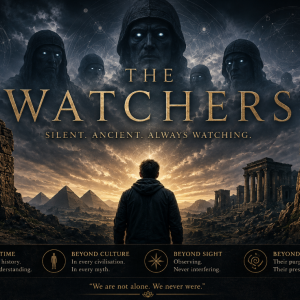
Ancient myths, religious traditions and modern theories surrounding the mysterious beings said to have observed, guided and influenced humanity.
Estimated reading time: 10 minutes
Between Worlds
The Mysterious Figures Who Appear Throughout History
Across thousands of years, cultures around the world have told stories about mysterious beings who watched humanity.
Sometimes they were described as guardians.
Sometimes teachers.
Sometimes messengers.
Sometimes rebels.
Their names varied depending on the culture, but the role they played was often remarkably similar.
They stood between worlds.
Between heaven and earth.
Between knowledge and ignorance.
Between the known and the unknown.
Among the most intriguing of these figures are those commonly known as the Watchers.
Who were they?
Were they mythological beings?
Symbolic characters?
Ancient teachers whose stories evolved over time?
Or something else entirely?
The answer depends on where we look.
In this investigation:
This article examines the Watchers of ancient religious texts, their association with forbidden knowledge, similar figures found across world mythology and why their story continues to influence modern theories and fiction.
The Ancient Tradition
What Are the Watchers?
The term “Watchers” is most commonly associated with ancient Jewish writings.
In these traditions, the Watchers were described as heavenly beings assigned to observe humanity.
The name itself suggests their role.
They watched.
They observed.
They monitored events unfolding in the human world.
However, the story becomes far more complicated than simple observation.
Some accounts suggest that certain Watchers became deeply involved in human affairs.
They abandoned their appointed role.
They interfered.
They revealed knowledge.
And according to the tradition, that involvement changed everything.
The Watchers were not condemned for seeing humanity. They were condemned for crossing the boundary between observer and participant.
The Primary Source
The Book of Enoch
Much of what people know about the Watchers comes from an ancient collection of writings known as the Book of Enoch.
Although the work is not included in most modern versions of the Bible, it was influential in parts of the ancient world.
The text presents Enoch as a righteous figure who receives visions concerning heavenly realms, divine judgement and the fate of rebellious beings.
According to the narrative, a group of Watchers descended to Earth.
Rather than merely observing humanity, they began interacting directly with human beings.
They taught knowledge.
Shared skills.
Revealed secrets.
And crossed boundaries they were never meant to cross.
The consequences of their actions became central to the story.
Their intervention brought both advancement and corruption.
The myth therefore presents knowledge as something double-edged:
- It can improve civilisation
- It can increase power
- It can undermine restraint
- It can create consequences beyond anyone’s control
Secrets Revealed
The Knowledge They Brought
One of the most fascinating aspects of the Watcher story involves the knowledge they allegedly shared.
Different versions of the tradition describe teachings connected to:
- Astronomy
- Mathematics
- Metalworking
- Weapon-making
- Agriculture
- Writing
- Medicine
- Cosmetics and adornment
- Divination
- The movement of celestial bodies
The implication is clear.
The Watchers were not merely observers.
They were teachers.
Bringers of knowledge.
Disruptors of the established order.
This theme appears repeatedly throughout ancient civilisations and world mythology.
Many cultures preserve stories about beings who introduced important skills, knowledge or laws to humanity.
The deeper question:
Was the knowledge itself considered dangerous, or was the real danger that humanity received it before developing the wisdom to use it responsibly?
A Parallel Myth
The Prometheus Connection
The Watchers are not unique in their role as bringers of forbidden knowledge.
Ancient Greek mythology contains a remarkably similar story.
The Titan Prometheus stole fire from the gods and gave it to humanity.
Fire represented more than warmth.
It symbolised:
- Knowledge
- Technology
- Craftsmanship
- Power
- Progress
- Civilisation
Prometheus was punished for sharing something that the gods had withheld.
The parallels are striking.
In both stories, a powerful being gives humanity access to transformative knowledge.
In both stories, the act violates an established boundary.
In both stories, progress carries a price.
The gift is valuable. The consequence is unavoidable.
This recurring pattern suggests that ancient societies understood something fundamental:
Knowledge changes the balance of power.
Recurring Figures
Watchers Around the World
Although the specific term “Watchers” comes from particular traditions, similar figures appear in cultures across the world.
Ancient Egypt
Many Egyptian myths describe divine beings associated with wisdom, writing, order, medicine and the preservation of sacred knowledge.
Figures connected with Thoth, Horus and the divine order of Ma’at helped explain how civilisation, law and cosmic balance were maintained.
The wider spiritual framework is explored in Ancient Egyptian Concepts of the Soul.
Mesopotamia
Ancient Sumerian and Mesopotamian traditions include powerful divine figures linked to civilisation, agriculture, writing and kingship.
These stories often present knowledge as something transmitted from the divine realm to humanity.
Ancient Greece
Prometheus is the clearest example, but Greek mythology contains many divine or semi-divine figures who teach, warn, guide or punish humanity.
Indigenous Traditions
Many indigenous cultures preserve stories of ancestral teachers, sky beings, culture heroes and guardians who guided early communities.
The details differ.
The underlying themes often remain surprisingly consistent.
- A mysterious teacher arrives
- Knowledge is shared
- Society changes
- A warning is ignored
- Consequences follow
History or Myth?
Were the Watchers Real?
This depends entirely on how the question is approached.
From a historical and archaeological perspective, there is no reliable evidence that supernatural Watchers literally descended from the heavens.
Historians generally interpret the stories as mythology, religious literature or symbolic tradition.
Yet mythology should not automatically be confused with meaningless falsehood.
Myths can preserve:
- Cultural memories
- Moral warnings
- Social values
- Historical anxieties
- Collective hopes
- Ideas about power and responsibility
Even when a story is not literally true, it may reveal important truths about how ancient people understood the world.
Investigator’s note:
A myth does not need to describe a literal event to contain historical, psychological or philosophical value.
The Watchers may therefore be understood as symbolic beings representing the arrival of transformative knowledge and the risks that accompany it.
The Birth of Legend
Why Ancient Cultures Created These Stories
The Watcher stories may have emerged from a simple observation.
Knowledge changes societies.
Throughout history, certain individuals and communities have introduced transformative ideas.
Writing.
Agriculture.
Engineering.
Astronomy.
Medicine.
Navigation.
To later generations, such innovations may have seemed almost supernatural.
It is not difficult to imagine how exceptional teachers, rulers or travellers could become legendary figures over time.
Stories grow.
Details evolve.
Historical individuals become heroes.
Heroes become divine.
Mythology develops.
The original inspiration may eventually become impossible to identify.
This process may help explain why similar culture-bringer stories appear throughout history.
The Dangerous Gift
The Watchers and Forbidden Knowledge
A recurring theme within Watcher traditions is the concept of forbidden knowledge.
The idea appears throughout mythology.
Certain knowledge is portrayed as:
- Powerful
- Dangerous
- Transformative
- Destabilising
- Reserved for the initiated
Knowledge itself is rarely presented as entirely evil.
The concern lies in how it is used.
Metalworking can create tools.
It can also create weapons.
Astronomy can guide navigation.
It can also become associated with prediction, ritual and political authority.
Medicine can heal.
It can also be used experimentally or without consent.
The dilemma remains relevant today.
Modern technologies such as artificial intelligence, genetic engineering and advanced computing raise similar questions.
Knowledge creates possibilities.
Human beings must decide how those possibilities are used.
The danger may not be knowledge itself. The danger may be power without wisdom.
The Enduring Mystery
Why the Watchers Continue to Fascinate Us
Part of the appeal lies in mystery.
The stories raise compelling questions.
- Where does knowledge come from?
- How does civilisation advance?
- Are some discoveries made too early?
- Can knowledge be dangerous?
- Should everything that can be discovered be revealed?
- Who decides when humanity is ready?
The Watchers represent these questions in symbolic form.
They embody the tension between:
- Curiosity and caution
- Progress and responsibility
- Discovery and consequence
- Freedom and control
- Knowledge and wisdom
Their appeal also connects with the psychology of the unknown.
The less certain we are about their origins, the more possibilities the imagination creates.
Modern Explanations
Modern Interpretations of the Watchers
Today, the Watchers are interpreted in many different ways.
Some people view them as:
- Mythological figures
- Religious beings
- Fallen angels
- Allegorical teachers
- Symbols of forbidden knowledge
- Ancient cultural memories
- Literary archetypes
Others connect them to speculative theories involving lost civilisations or extraterrestrial visitors.
Such theories often argue that the rapid development of ancient societies required intervention from an advanced external source.
These ideas remain popular in books, documentaries and online discussions.
However, they are not supported by mainstream historical or archaeological evidence.
Evidence matters:
The similarity of myths across cultures is interesting, but similarity alone does not prove that every tradition describes the same literal event.
Nevertheless, the theories demonstrate how strongly the Watchers continue to capture the imagination.
The Human Mind
The Psychology of the Watchers
There may also be a psychological explanation for why these stories endure.
Human beings naturally seek guidance.
Throughout history, societies have looked to:
- Elders
- Teachers
- Philosophers
- Religious leaders
- Scientists
- Guardians
- Mentors
The Watchers may represent a powerful archetype.
The wise observer.
The guardian of knowledge.
The mentor who helps others grow.
But they also represent the shadow side of that archetype.
The teacher who manipulates.
The guardian who interferes.
The authority who decides what others are allowed to know.
This duality may explain why the Watchers appear as both protectors and rebels.
Their story reflects humanity’s complicated relationship with authority and hidden knowledge, themes also examined in Who Really Holds Power?.
The Central Lesson
Knowledge and Responsibility
Perhaps the most important lesson within the Watcher stories concerns responsibility.
Knowledge alone is not enough.
Wisdom matters.
Understanding matters.
Character matters.
Throughout history, advances in knowledge have created both opportunities and risks.
The challenge has always been deciding how that knowledge should be used.
The Watcher myths remind us that learning and responsibility must develop together.
The lesson of the Watchers:
Knowledge increases capability.
Capability increases power.
Power increases responsibility.
Without wisdom, progress can become destruction.
A Deeper Interpretation
What If the Stories Contain a Deeper Meaning?
Whether viewed as history, mythology or symbolism, the Watcher traditions raise enduring questions.
Why do certain ideas emerge when they do?
How does knowledge spread?
Who controls access to it?
What responsibilities accompany understanding?
The stories may not provide definitive answers.
But they encourage reflection.
And sometimes the questions are more important than the answers.
The Watchers may represent the human desire to believe that someone—or something—understands the mysteries beyond our reach.
That desire also connects with why humans search for meaning and why we continually look beyond ordinary experience for deeper explanations.
Ancient Questions, Modern Technology
Why the Watchers Matter Today
In an age of rapid technological change, the themes surrounding the Watchers feel surprisingly modern.
Humanity now possesses knowledge and capabilities that previous generations could scarcely imagine.
- Artificial intelligence
- Gene editing
- Quantum computing
- Space exploration
- Brain-computer interfaces
- Advanced surveillance
- Autonomous weapons
The same questions remain.
How should knowledge be used?
What responsibilities accompany discovery?
Should every technological possibility be pursued?
Who should control powerful discoveries?
What happens when wisdom fails to keep pace with power?
These concerns are as relevant today as they were in ancient stories.
The technology changes. The moral question remains.
Inside the Fiction
The Watchers in the Jonathan Chambers Universe
Within the Jonathan Chambers universe, The Watchers represent those willing to look beyond accepted explanations.
They investigate.
They observe.
They question.
They search for patterns hidden beneath official history.
The name reflects the ancient idea of guardians positioned between knowledge and ignorance.
But unlike the rebellious beings of ancient myth, the modern Watchers are not presented as supernatural rulers.
They are readers, investigators and seekers.
People who understand that mysteries should be approached with both curiosity and caution.
The novels draw on the same themes found in ancient traditions:
- Hidden knowledge
- Forbidden research
- Powerful organisations
- Ancient symbolism
- Consciousness
- The consequences of discovery
These ideas are developed further through The Watchers and the restricted material available throughout the Jonathan Chambers site.
Final Thoughts
Who Were the Watchers?
The Watchers remain among the most intriguing figures in mythology.
Whether interpreted as heavenly beings, symbolic teachers, cultural memories or literary archetypes, they continue to capture the imagination.
Their stories explore themes that remain deeply relevant:
- Knowledge
- Curiosity
- Responsibility
- Progress
- Power
- Human potential
Perhaps that is why the legends endure.
The Watchers may be ancient.
The questions they raise are timeless.
Who should possess knowledge?
When should it be revealed?
What happens when power advances faster than wisdom?
And who watches those who believe they are watching over everyone else?
As long as humanity continues searching for understanding, stories about those who guard, share or reveal hidden knowledge will remain part of our collective imagination.
Go Beyond the Article
Some Mysteries Are Meant to Be Watched
The Jonathan Chambers novels explore ancient knowledge, hidden organisations, consciousness, forbidden research and the dangerous boundary between discovery and control.