Power, Influence and Hidden Networks
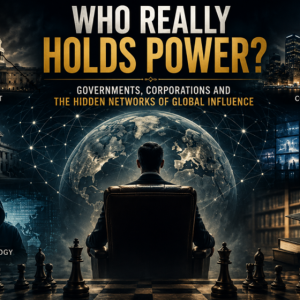
Who Really Holds Power?
Governments, corporations and the complex networks of influence that shape the modern world.
Estimated reading time: 10 minutes
The Central Question
Who Shapes the World We Live In?
When we think about power, governments usually come to mind first.
After all, governments pass laws, collect taxes, maintain armed forces and negotiate international agreements.
But is political power the only kind of power that shapes our lives?
History suggests otherwise.
Throughout civilisation, influence has flowed through many different channels:
- Governments
- Wealth
- Religion
- Trade
- Technology
- Education
- Information
Some power is visible.
Some is hidden in plain sight.
Understanding how influence works has become one of the most fascinating subjects in history, economics and political science.
In this investigation:
Who really influences the decisions that shape our lives? This article examines political, economic, technological, media and institutional power while distinguishing documented influence from speculation and conspiracy.
Across History
Power Has Always Been Concentrated
History shows that power has rarely been shared equally.
Ancient civilisations were often organised around rulers, priesthoods, military leaders and wealthy families.
Ancient Egypt had its Pharaohs.
Rome had its Emperors.
Medieval Europe was dominated by kings, noble families and religious authorities.
The Renaissance saw wealthy merchant families shape politics through finance and trade.
The Industrial Revolution shifted influence towards factory owners, industrialists and bankers.
Today, multinational corporations, technology companies and financial institutions possess resources that rival those of many governments.
Power has evolved. It has never disappeared.
The names, institutions and technologies change, but the struggle over who controls resources, information and decision-making remains.
Scale and Reach
Economic Influence Beyond Borders
Did you know?
Some multinational companies generate annual revenues greater than the economic output of smaller nations.
That does not make them governments, but it demonstrates how economic influence can extend far beyond the marketplace.
Large companies may employ hundreds of thousands of people, control supply chains across continents and influence the development of entire industries.
Their decisions can affect:
- Employment
- Prices
- Technology
- Transport
- Energy
- Health
- Communication
Economic influence does not always require direct political authority.
Sometimes the ability to invest, withdraw investment, create employment or control access to technology is influential enough.
A Network, Not a Pyramid
The Different Forms of Power
Power is often imagined as a pyramid.
A small group sits at the top while everyone else remains below.
Reality is usually more complicated.
Modern power resembles a network.
Different institutions influence society in different ways, often working together, competing with one another or pursuing entirely separate goals.
Political Power
Governments create laws, regulate markets, control taxation and make decisions concerning national security.
They possess the formal authority to enforce those decisions.
Economic Power
Banks, investment firms, corporations and wealthy individuals influence employment, innovation, property, international trade and access to capital.
Media Power
News organisations, broadcasters, publishers and social platforms influence which issues receive attention and how those issues are presented.
This relates closely to the way our thoughts, assumptions and perceptions shape reality.
Technological Power
Technology companies increasingly influence communication, commerce, artificial intelligence, data collection and access to information.
Academic and Scientific Power
Universities, research institutions and scientific organisations influence medicine, public policy, technology and our understanding of the world.
Cultural Power
Artists, writers, filmmakers, musicians and public figures can influence values and public attitudes without possessing political or economic authority.
Key point:
No single group controls every aspect of modern society.
Instead, overlapping centres of influence create a complex and constantly changing network.
Money and Access
Wealth and Political Influence
Throughout history, wealth has often translated into political influence.
Large organisations and wealthy individuals may:
- Fund election campaigns
- Support research institutes and think tanks
- Lobby elected representatives
- Own or invest in media organisations
- Invest in strategic industries
- Endow universities and charities
- Fund public campaigns
Many of these activities are public and regulated by law.
The extent to which they influence public policy remains the subject of ongoing debate among economists, historians and political scientists.
The important distinction is between access and absolute control.
Money can create opportunities to influence decision-makers, but it does not guarantee that every desired outcome will be achieved.
Investigator’s note:
Influence should not automatically be confused with control.
People and organisations can exert significant pressure without directing every political decision or historical event.
Recognising that distinction is essential when evaluating extraordinary claims.
Information
Who Controls What We See?
Information has always been a source of power.
Ancient rulers recorded victories and concealed defeats.
Religious institutions preserved knowledge and controlled access to sacred texts.
Kings and governments used proclamations, newspapers and official records to shape public understanding.
Today, information moves at extraordinary speed.
Search engines, social media platforms and digital publishers determine which information appears first and which stories disappear beneath an endless stream of content.
The issue is not necessarily that one organisation controls everything.
The greater concern is that algorithms, commercial incentives and human behaviour can collectively shape what millions of people see.
This can influence:
- Political opinions
- Consumer behaviour
- Public fears
- Social values
- Trust in institutions
The relationship between information and belief also helps explain why unanswered questions and hidden explanations captivate the human mind.
Patterns and Explanations
Why Do Conspiracy Theories Develop?
Human beings naturally search for patterns.
When major events occur—financial crashes, wars, pandemics or political upheavals—we instinctively ask:
Who benefited?
Who was responsible?
Sometimes history reveals clear answers.
Governments have concealed information.
Companies have covered up wrongdoing.
Intelligence agencies have conducted secret operations.
Individuals have conspired for wealth, influence or political advantage.
But not every major event has a single architect.
Some events result from thousands of independent decisions, institutional failures and unintended consequences.
People are often more likely to believe in hidden coordinating forces during periods of uncertainty, rapid social change or declining trust in institutions.
This does not mean every concern about concentrated power is unfounded.
It means we should avoid mistaking complexity for coordination without sufficient evidence.
Behind Closed Doors
Secret Societies and Hidden Influence
History contains many genuine secret, private or exclusive organisations.
These include:
- Religious orders
- Intelligence agencies
- Fraternal organisations
- Exclusive political clubs
- Business networks
- Diplomatic alliances
- Military organisations
Some have exercised considerable influence.
Others have been far less important than later myths suggest.
Most operated within specific historical, political or cultural contexts rather than directing all world events.
Private meetings and confidential organisations can create suspicion because outsiders do not know what is being discussed.
But secrecy alone is not evidence of unlimited control.
Evidence matters:
The existence of a private organisation does not, by itself, demonstrate the existence of a hidden global authority.
Claims should be examined through reliable records, verifiable evidence and historical context.
Ancient Authority
Religion, Symbols and Power
Power has never depended solely on money or military strength.
Belief can be equally influential.
Ancient rulers frequently associated themselves with gods, sacred symbols and divine authority.
In ancient Egyptian beliefs about the soul, the Pharaoh occupied a central position between human society and the divine order.
Symbols such as the Ankh represented life, continuity and spiritual authority.
The Eye of Horus represented protection, restoration and royal power.
These symbols were more than decorative objects.
They reinforced shared beliefs about who possessed authority and why that authority should be accepted.
Modern institutions use different symbols, but the underlying principle remains.
Flags, logos, uniforms, buildings and ceremonies all communicate legitimacy and belonging.
The Digital Age
Technology as a New Centre of Power
Technology has created forms of influence that previous generations could barely imagine.
A small number of platforms now mediate communication between billions of people.
They influence:
- How information is discovered
- Which businesses reach customers
- How political movements organise
- Which opinions gain attention
- How personal data is collected
- How artificial intelligence develops
This does not mean technology companies operate as a single coordinated force.
They compete aggressively with one another and remain subject to governments, courts, investors and public opinion.
Nevertheless, control over digital infrastructure creates a form of influence that did not exist a generation ago.
The modern struggle for power increasingly concerns data, attention and access rather than only territory or physical resources.
The Attraction of a Hidden Elite
Why the Idea Endures
The concept of a hidden elite continues to appear in novels, films and documentaries because it reflects a deeper human question:
Who really makes the decisions that shape our lives?
Sometimes the answer is obvious.
A government passes a law.
A court delivers a judgement.
A company launches a product.
A bank approves or withdraws funding.
At other times, responsibility is distributed across thousands of organisations and individuals.
Reality is often less dramatic than a single conspiracy.
But it is frequently more complicated.
This complexity can be unsatisfying.
A hidden mastermind offers a simple explanation.
Networks, incentives, institutions and unintended consequences do not.
Inside the Fiction
The Jonathan Chambers Perspective
The Jonathan Chambers novels explore these themes through fiction.
Within the series, the Black Sun Council is an entirely fictional organisation representing the timeless struggle between concentrated control and individual freedom.
Its members possess wealth, influence, knowledge and access to technologies unavailable to the wider world.
Their power lies not simply in money, but in their ability to influence institutions, conceal information and shape belief.
The idea draws inspiration from history’s recurring questions about power, secrecy and influence—not from claims that a real-world hidden organisation controls global events.
The novels invite readers to ask difficult questions while recognising the importance of distinguishing between:
- Established historical evidence
- Reasonable interpretation
- Speculation
- Fiction
That distinction lies at the heart of every investigation.
The theme also connects with wider questions explored throughout the Jonathan Chambers universe, including whether our choices are truly our own and why humans search for meaning.
Critical Thinking
How Should Claims About Power Be Investigated?
Questions about power should not be dismissed.
History contains enough documented corruption, secrecy and abuse to justify careful investigation.
But investigation requires more than suspicion.
Useful questions include:
- What evidence supports the claim?
- Can that evidence be independently verified?
- Are the sources reliable?
- Is there a simpler explanation?
- Does the theory account for conflicting interests?
- Would the alleged conspiracy realistically remain secret?
- Who benefits from promoting the claim?
Healthy scepticism works in both directions.
We should not accept extraordinary claims without evidence.
But neither should we assume that powerful institutions are always transparent or trustworthy.
The investigator’s approach:
Remain curious.
Question confidently.
Follow the evidence.
Be prepared to change your conclusion.
Final Thoughts
Who Really Holds Power?
Power has always existed.
It has simply changed form.
From kings and emperors to merchants, industrialists, governments and multinational corporations, the individuals and institutions influencing society continue to evolve.
Modern power is distributed across political systems, wealth, media, technology, academia, culture and information.
No single organisation controls every decision.
Yet some institutions possess far more influence than others.
Understanding those systems requires curiosity, critical thinking and a willingness to examine evidence carefully.
History is rarely as simple as popular myths suggest.
Nor is it always as transparent as we might hope.
Perhaps the most important lesson is not to accept every claim—or dismiss every question.
Instead, continue investigating.
Go Beyond the Article
Some Questions Lead to Bigger Mysteries
The Jonathan Chambers novels explore hidden organisations, ancient knowledge, concentrated power and humanity’s continuing struggle for freedom.