
Science, Innovation and Mystery
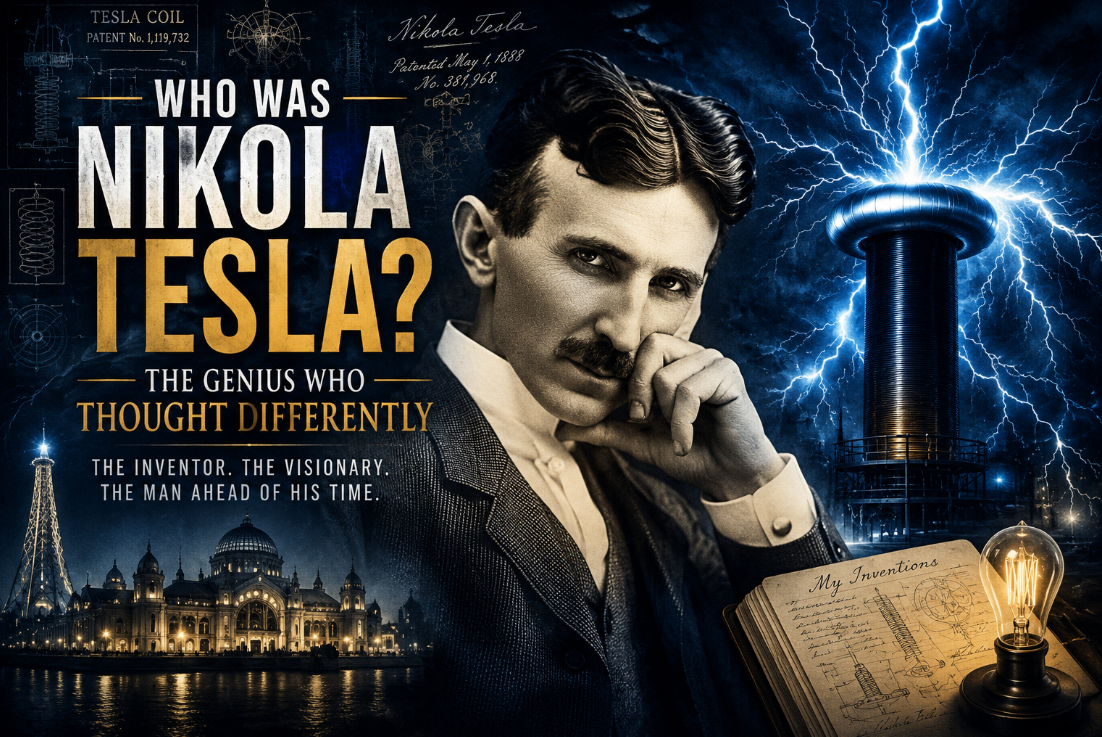
Who Was Nikola Tesla?
The genius who thought differently, helped build the modern electrical world and became one of history’s most mysterious inventors.
Visionary Inventors
The Inventor Who Helped Build the Modern World
Mention the name Nikola Tesla and most people think of electricity.
Some think of lightning bolts.
Others think of mystery, conspiracy theories, secret inventions, or even science fiction.
Yet the truth is remarkable enough without exaggeration.
Nikola Tesla was one of the most brilliant inventors in human history. Many of the technologies we use every day can trace their roots back to ideas that originated in his extraordinary mind.
Yet despite his achievements, Tesla died alone, largely forgotten by the world he helped transform.
Today he is remembered not only as a genius but as a symbol of what happens when imagination, vision, and relentless curiosity collide.
So who was Nikola Tesla?
And why does his story continue to fascinate people more than eighty years after his death?
In this investigation: Discover how Nikola Tesla helped shape the modern electrical world, why his ideas were so far ahead of their time and how fact, myth and mystery became intertwined around his legacy.
Origins
A Boy Born During a Lightning Storm
Nikola Tesla was born on July 10th, 1856, in the village of Smiljan, then part of the Austrian Empire and now located in modern-day Croatia.
According to family legend, he was born during a violent thunderstorm.
As lightning flashed across the sky, the midwife supposedly declared the child would be a child of darkness.
Tesla's mother reportedly replied:
“No. He will be a child of light.”Family legend about Tesla’s birth during a thunderstorm
Whether true or not, it is a fitting story for a man whose work would help electrify the world.
Genius
An Extraordinary Mind
From a young age, Tesla displayed unusual abilities.
He possessed an almost photographic memory.
He could perform complex calculations entirely in his head.
Most remarkably, he could visualise inventions in complete detail before building them.
Tesla later explained that he could mentally construct machines, operate them, test them, and identify flaws without ever touching a physical tool.
He did not simply imagine ideas.
He appeared to see them.
This ability allowed him to work in ways that astonished those around him.
Electricity
The War of the Currents
Tesla's most famous contribution came through his work on electrical power systems.
At the time, much of the world was being electrified using direct current (DC), championed by inventor Thomas Edison.
Tesla believed there was a better approach.
He advocated alternating current (AC).
Unlike direct current, alternating current could travel long distances efficiently, making it far more practical for supplying electricity to cities and towns.
This disagreement sparked what became known as the War of the Currents.
Edison fiercely defended DC power.
Tesla worked with George Westinghouse to promote AC systems.
History ultimately proved Tesla correct.
Today, alternating current remains the foundation of electrical power distribution throughout much of the world, making Tesla central to the story of modern scientific thinking and technological progress.
Every time you switch on a light, charge a device, or power your home, you are benefiting from Tesla's vision.
Innovation
The Man Behind Modern Technology
Many people know Tesla for electricity, but his contributions extended much further.
His work laid foundations for:
- Radio communication
- Wireless transmission
- Electric motors
- Remote control technology
- High-frequency power systems
- Robotics concepts
- Modern power grids
Some historians argue that Tesla's influence on modern technology rivals that of any inventor who ever lived.
The challenge is that many of his contributions were either overshadowed or credited to others during his lifetime.
Energy and Resonance
The Tesla Coil
One of Tesla's most famous inventions remains the Tesla Coil.
The device generates spectacular electrical discharges and demonstrates principles of resonance and wireless energy transfer.
Photographs of Tesla standing calmly among giant arcs of electricity have become iconic images of scientific innovation.
Although the Tesla Coil has limited commercial use today, it remains an important educational tool and a symbol of Tesla's fascination with energy, frequency, and resonance.
These themes would dominate much of his later work.
A Connected World
The Dream of Wireless Energy
Tesla's greatest ambition was not simply generating electricity.
He wanted to distribute it wirelessly.
He imagined a world where power and information could travel freely across the planet, a vision that connects with humanity's broader fascination with power, control and hidden influence.
Long before smartphones, Wi-Fi, satellites, and wireless communication existed, Tesla envisioned a globally connected network.
Many of his predictions sound astonishingly modern.
He spoke of handheld communication devices.
Instant global communication.
Wireless transmission of information.
Technologies that would not become commonplace until decades after his death.
The Great Experiment
Wardenclyffe Tower
Perhaps Tesla's most ambitious project was Wardenclyffe Tower.
Built on Long Island, New York, the enormous structure was intended to demonstrate wireless transmission on a global scale.
Tesla believed the Earth itself could be used as part of an electrical transmission system.
His goal was nothing less than worldwide communication and power distribution.
Unfortunately, funding problems plagued the project.
Investors became sceptical.
Construction stalled.
The tower was eventually abandoned and later demolished.
Many historians consider Wardenclyffe one of the greatest "what if?" stories in scientific history.
What might have happened if Tesla had completed it?
The Human Cost
Genius and Isolation
Despite his brilliance, Tesla struggled throughout much of his life.
He became increasingly isolated.
Financial difficulties followed him.
Many of his ideas were considered too ambitious or impractical.
As he grew older, he devoted himself to increasingly unconventional projects.
Some were visionary.
Some were speculative.
Some may never have been technically feasible.
This mixture of genius and mystery contributed greatly to Tesla's enduring legend and explains why he remains one of the most compelling figures in the world's great unsolved mysteries.
A Disputed Legacy
Did Tesla Invent Radio?
This question remains surprisingly controversial.
For many years, Guglielmo Marconi was widely credited with inventing radio.
However, Tesla held earlier patents covering many of the underlying technologies.
In 1943, shortly after Tesla's death, the United States Supreme Court recognised key Tesla patents that predated Marconi's claims.
Today many historians acknowledge Tesla as one of the primary pioneers of radio communication.
Legend and Speculation
The Rise of the Tesla Myth
After his death in 1943, interest in Tesla began to grow.
Some of this interest was based on legitimate scientific achievements.
Some evolved into speculation.
Stories emerged about:
- Secret energy weapons
- Suppressed inventions
- Lost notebooks
- Government confiscation of research
- Revolutionary technologies hidden from the public
While many of these claims lack evidence, they helped transform Tesla into something larger than life.
He became part scientist, part legend, occupying the same space between documented history and speculation explored in the history of secret societies.
Enduring Fascination
Why Tesla Captures Our Imagination
Few historical figures inspire the same fascination as Tesla.
Part of the reason is that he seems to embody the ideal image of the visionary inventor.
He was driven more by ideas than money.
More interested in discovery than profit.
He appeared to care less about wealth and more about understanding the universe.
Tesla once famously stated:
“If you want to find the secrets of the universe, think in terms of energy, frequency and vibration.”Quotation widely associated with Nikola Tesla
Whether interpreted scientifically, philosophically, or spiritually, those words continue to resonate today.
Beyond Invention
Tesla and the Search for Bigger Questions
What makes Tesla particularly interesting is that he was never satisfied with small answers.
Electricity was not enough.
Communication was not enough.
He continually searched for deeper connections between energy, matter, nature, and the universe itself.
Many people are drawn to Tesla because he reminds us that curiosity has no finish line.
Every discovery creates new questions.
Every answer opens another door, which is why Tesla's story fits naturally beside investigations into consciousness, the pineal gland and the nature of reality.
Lessons From a Visionary
What Can We Learn From Tesla?
Tesla's story offers several powerful lessons.
Think Differently
Many of Tesla's ideas were dismissed before later becoming reality.
Innovation often begins where conventional thinking ends.
Curiosity Matters
Tesla never stopped asking questions.
The desire to understand is one of humanity's greatest strengths.
Failure Is Not Final
Wardenclyffe failed.
Many projects failed.
Yet Tesla's broader influence reshaped the world.
Success is rarely a straight line.
Vision Can Outlive a Lifetime
Tesla died with little wealth.
Yet decades later, his ideas continue to influence modern technology.
Some contributions take time to be fully appreciated.
Legacy
Final Thoughts
Nikola Tesla was not merely an inventor.
He was a visionary.
A thinker who looked beyond the limits of his era and imagined possibilities that others could not yet see.
Some of his dreams succeeded.
Others failed.
Many remain debated to this day.
But there is little doubt that the modern world would look very different without him.
More than eighty years after his death, Tesla continues to inspire scientists, engineers, dreamers, and anyone who has ever wondered what might be possible if we dared to think differently.
And perhaps that is his greatest legacy.
Not a machine.
Not a patent.
Not an invention.
But a reminder that progress begins with imagination.
Explore More Mysteries of Science and Consciousness
If you enjoy exploring the intersection of science, hidden history, consciousness, ancient knowledge, and the unanswered questions that continue to challenge our understanding of reality, discover the Jonathan Chambers novels.
Because every great mystery begins with a question.
Go Beyond the Article
Every Great Mystery Begins With a Question
The Jonathan Chambers novels explore science, consciousness, hidden history, ancient knowledge and the ideas that challenge our understanding of reality.