
Ancient Medicine & Consciousness
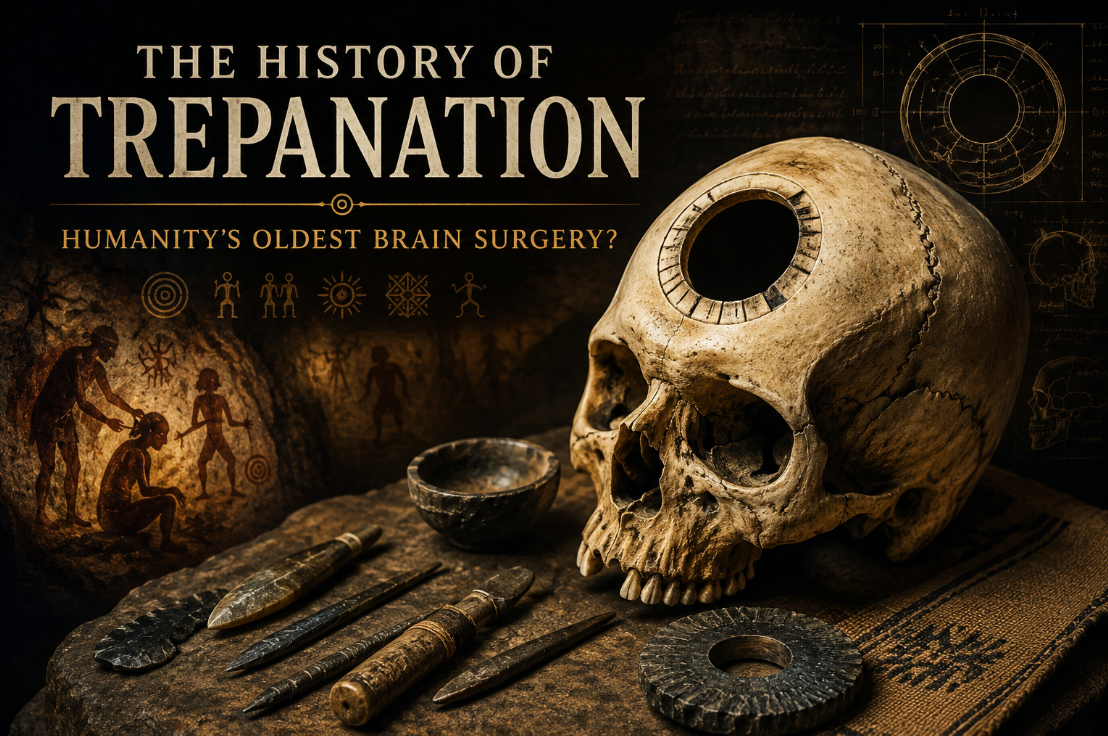
The History of Trepanation: Humanity’s Oldest Brain Surgery?
One of archaeology’s greatest medical mysteries: why did ancient people deliberately open the human skull—and how did so many patients survive?
Ancient Surgery
A Hole in the Skull—and a Medical Mystery
Thousands of years before modern hospitals, anaesthesia or sterile operating theatres, human beings were performing one of the most extraordinary procedures in medical history: removing part of the skull from a living patient.
The practice is known as trepanation, or trephination. Archaeologists have discovered trepanned skulls across Europe, Africa, Asia, the Middle East and the Americas. Some date from the prehistoric period, making trepanation one of the oldest known forms of surgery.
The purpose of the operation remains uncertain. In some cases it may have been a practical response to injury. In others, the opening may have carried ritual or spiritual meaning. The procedure stands at the meeting point between medicine, belief and the ancient search to understand the human mind.
Trepanation reveals that ancient societies were not merely observing the body. They were prepared to intervene in it—sometimes with remarkable skill.
The Procedure
What Is Trepanation?
Trepanation is the deliberate creation of an opening in the skull. The procedure usually involved removing a small section of bone while attempting to leave the protective membrane surrounding the brain intact.
Ancient practitioners used several different techniques. The method chosen depended on the culture, the tools available and the reason for the operation.
Scraping
Bone was gradually worn away using a sharp stone or abrasive tool.
Grooving
A circular or rectangular groove was cut repeatedly until the centre could be lifted away.
Drilling
A series of small holes was created and joined together to remove a larger section.
Cutting
Sharp blades or chisels were used to remove a carefully shaped piece of skull.
The operation sounds crude by modern standards, but many skulls show signs of bone healing around the opening. This means that the patient survived not merely for hours or days, but often for months or years.
Prehistoric Evidence
How Old Is Trepanation?
Trepanation reaches deep into prehistory. Examples have been found among early farming communities and in cultures separated by thousands of miles. The widespread nature of the practice suggests that it was discovered independently more than once.
Trepanned skulls have been uncovered in locations including France, Britain, Germany, Russia, China, North Africa, the Middle East and the Andes. The procedure appears in societies with no known contact with one another.
North Africa
China
The Middle East
Peru
Bolivia
Russia
Britain
This geographical spread raises an intriguing question: did ancient healers repeatedly discover that opening the skull could relieve certain symptoms, or was the practice driven by beliefs that appeared independently across different cultures?
Medicine, Ritual or Both?
Why Was Trepanation Performed?
There was probably no single reason. Trepanation may have served different purposes in different places and periods. A practical surgical technique could also have carried religious significance, especially in cultures where physical illness and spiritual imbalance were not viewed as separate problems.
Medical Treatment
A skull opening may have been used to treat fractures, reduce pressure following injury, remove damaged bone or relieve symptoms after a violent blow to the head.
Spiritual Healing
Some communities may have believed that illness, seizures or unusual behaviour were caused by spirits, curses or forces trapped within the body.
Ritual Transformation
The procedure may also have marked initiation, status, healing or an attempt to change awareness and a person’s relationship with the unseen world.
It is tempting to divide ancient explanations into either medicine or superstition. Ancient people may not have recognised that distinction. A healer could treat a physical injury while also performing a ritual intended to restore spiritual balance.
That overlap connects trepanation with wider questions explored in What Is Consciousness? and the ways ancient societies understood the relationship between body, identity and soul.
The Andes
Ancient Peru: Masters of Skull Surgery
Some of the most striking evidence comes from ancient Peru. Large numbers of trepanned skulls have been found in the Andes, particularly among cultures where warfare and blunt-force head injuries were common.
The openings vary in shape and technique. Some skulls contain more than one operation, with clear healing around earlier openings. A person who underwent repeated trepanation must have survived the first procedure long enough to require another.
What the Peruvian evidence suggests
- Practitioners understood how to avoid certain fatal areas of the skull.
- Different techniques were selected for different injuries.
- Patients received some form of care after the operation.
- Knowledge may have improved over generations.
These were not necessarily isolated experiments. The evidence suggests an established practice built on accumulated experience. Whatever beliefs surrounded the operation, some practitioners were learning from the results.
Europe
Trepanation in Prehistoric Europe
European examples range from the Neolithic period into the Bronze and Iron Ages. Openings may be circular, oval or rectangular, reflecting different methods of scraping and cutting.
Some pieces of removed bone appear to have been kept. These fragments may have served as amulets, charms or objects of ritual importance. That possibility strengthens the argument that trepanation sometimes had significance beyond physical treatment.
The practice continued into the classical and medieval worlds, where surgery became more formally documented. Later physicians used trepanation to treat head wounds and fractures, particularly injuries caused by weapons.
Ancient Technology
What Tools Were Used?
The earliest operators worked without steel instruments, powered drills or medical imaging. They relied on tools made from the materials available to them and on an intimate understanding of resistance, pressure and bone.
Flint
Capable of producing an exceptionally sharp edge for cutting and scraping.
Obsidian
Volcanic glass that can fracture into blades finer than many metal edges.
Stone Scrapers
Used gradually to thin the skull and reduce the risk of penetrating too deeply.
Metal Instruments
Bronze and later iron tools allowed more specialised cutting and drilling techniques.
Scraping may have been slow, but that slowness could be an advantage. It gave the operator greater control and reduced the danger of suddenly plunging through the bone into the brain.
Survival
Was Trepanation Successful?
The strongest evidence of success is written into the bone itself. When a patient survived, the edge of the opening began to remodel and smooth over. Archaeologists can distinguish this healing from damage that occurred at or after death.
Not every patient survived, and the risks must have been considerable. Bleeding, shock, brain injury and infection could all prove fatal. Yet the number of healed skulls demonstrates that ancient surgery was not automatically a death sentence.
Survival also implies aftercare. A patient recovering from skull surgery would have needed protection, food, rest and attention from others. Trepanation therefore offers evidence not only of surgical knowledge, but of organised care within ancient communities.
Mind and Symbolism
Trepanation, Consciousness and the Pineal Gland
Modern discussions sometimes connect trepanation with altered consciousness or the mystery of awareness. The opening of the skull is occasionally interpreted as an attempt to release pressure, admit spiritual influence or change perception.
There is no convincing evidence that ancient operators were specifically targeting the pineal gland. The gland lies deep within the brain and could not have been reached safely through a simple opening in the skull.
Even so, the symbolic connection is understandable. Across history, the head has represented identity, thought and the soul. Ancient Egyptian ideas about life and immortality—explored further in What Is the Ankh? and Ancient Civilisations—show how strongly physical and spiritual interpretations could overlap.
Trepanation may not have been a search for the pineal gland, but it was part of humanity’s much older search for the source of pain, behaviour, identity and consciousness.
A Lasting Fascination
Why Does Trepanation Still Fascinate Us?
Trepanation challenges the assumption that prehistoric medicine was entirely primitive. The surviving skulls point to observation, specialised tools, practical knowledge and the courage to perform an operation with immediate and obvious risks.
- Surgical skill: operators could remove bone without always causing fatal damage.
- Anatomical awareness: repeated survival suggests knowledge of safer and more dangerous areas.
- Patient care: healing required support long after the operation ended.
- Shared belief: the procedure may have united physical treatment with ritual meaning.
It also confronts us with a question that remains familiar today: how far should people go in an attempt to heal the body, alter the mind or reach beyond ordinary human experience?
Fiction Rooted in History
Trepanation in the Jonathan Chambers Universe
The Jonathan Chambers novels explore the uneasy territory where neuroscience, ancient belief and human ambition collide. Trepanation belongs naturally within that world because it is real, unsettling and still surrounded by unanswered questions.
In the fictional world of the Ankh Institute, brain surgery becomes part of a much larger investigation into consciousness, death and the possibility that the mind is more than a product of the brain.
Those themes also run through What Happens When We Die?, where ancient beliefs are placed beside modern attempts to understand death and continued awareness.
Final Thoughts
Humanity’s Oldest Brain Surgery?
Trepanation was dangerous, invasive and, in some cases, astonishingly successful. It reveals a level of determination that is difficult to ignore. Ancient healers were willing to open the skull because they believed something inside could be repaired, released or transformed.
We may never know exactly what every operation was intended to achieve. The archaeological evidence cannot preserve the words, fears or beliefs of the patient. It can, however, show that many survived.
That survival transforms trepanation from a strange ritual into something more significant: evidence that ancient people were experimenting with surgery, caring for the injured and asking questions about the human head that medicine and philosophy are still trying to answer.
Continue The Investigation
More Reading
Explore more real mysteries, ancient beliefs and scientific questions behind the Jonathan Chambers universe.
What Is Consciousness?
Explore awareness, identity and the greatest mystery of the human mind.
Ancient Civilisations
Discover lost knowledge, sacred traditions and ancient explanations of existence.
What Happens When We Die?
Compare ancient beliefs about death with modern scientific investigation.
What Is the Ankh?
Uncover the history and symbolism of ancient Egypt’s most recognisable icon.
The Mystery Files
Go deeper into hidden history, unexplained discoveries and controversial ideas.
Jonathan Chambers Novels
Discover historical mysteries inspired by real questions and ancient secrets.